

Friday , October 2, 2026
For seven days, Busoga did more than pray.
From September 21 to 27, religious, political, cultural and development leaders joined thousands of residents under one call — “Let Us Rise Up and Build” — turning the fourth Busoga Prayer Week into a wider conversation about unity, household transformation, wealth creation and the region’s journey towards its Vision 2030 aspirations.
The Prayer Week, coordinated by the Busoga Consortium for Development (BCD) in collaboration with the Inter-Religious Council of Uganda (IRCU), Busoga Chapter, brought together six faith denominations — Anglican, Catholic, Orthodox, Pentecostal, Seventh-day Adventist and Muslim communities. But its significance went beyond the religious gatherings. It gave Busoga an opportunity to reflect on progress under the 10-year Busoga Development Agenda, examine challenges slowing implementation and renew the call for leaders, institutions and citizens to take responsibility for transforming the region.
The theme, drawn from Nehemiah 2:18, carried a message that resonated with Busoga’s development aspirations. In the biblical account, Nehemiah’s people did not stop at prayer. They assessed what had been broken, organised themselves, united around a common purpose and began rebuilding. For Busoga, the message was equally practical: prayer must be followed by action. Throughout the week, leaders used different platforms to challenge Basoga to look beyond political, religious and personal differences and focus on the common task of development.
At the opening of the Prayer Week on September 21, Rt. Hon. Rebecca Alitwala Kadaga, First Deputy Prime Minister and Patron of the BCD, called upon economically prosperous Basoga living outside the region to return home, establish homes and investments and contribute to the transformation of the sub-region. The following day, Owek. Dr. Joseph Muvawala, Katukiro of Busoga Kingdom, called on Basoga to rise above their differences and unite around a common purpose.
During the Catholic day, Rt. Hon. Justine Kasule Lumumba, Minister for ICT and National Guidance, shifted the focus to the household, stressing that the fight against poverty requires the participation of individuals and families. On the Orthodox day, Hon. Princess Persis Namuganza, who attended as guest of honour, called on faith institutions to play a stronger role in mobilising communities for wealth creation and complementing government development efforts.
Dr. Anthony Mula, Director General of the BCD, and Hon. Stephen Kisa, Chairperson of the organising committee, emphasised the importance of technical and parliamentary coordination to support timely decision-making and implementation of agreed policies and initiatives. The different messages converged around a central reality: Busoga’s transformation cannot be the responsibility of government alone.
The Prayer Week also offered a platform to reflect on the implementation of the 10-year Busoga Development Agenda, launched in October 2020 as a framework for coordinating development efforts across the sub-region. At the regional climax in Mayuge, Rt. Hon. Rukia Isanga Nakadama, Third Deputy Prime Minister and Chairperson of the Busoga Ministerial Coordination Committee, said a number of interventions under the agenda were beginning to translate into tangible benefits for communities.She, however, raised a concern that inadequate funding to the BCD was slowing implementation and limiting the expansion of some programmes.
One of the interventions she highlighted was the Village Agriculture Model (VAM), which has been rolled out in three model villages — Namayombe in Namayingo District, Mashaiga B in Mayuge and Busana in Kamuli. The model is designed to move households towards commercial agriculture and wealth creation, with farmers embracing soybean and poultry production as sources of income. The programme is also increasingly focusing on what happens after production.
With support from partners including China Agricultural University, communities are moving into soybean value addition, including processing soy milk for school feeding programmes.
The initiative is intended to improve nutrition and pupils’ performance while supporting efforts to revive school gardens in public schools as sources of food and practical agricultural learning. Improved Rainbow chicken has also been introduced through the model villages, providing households with another opportunity to diversify income. For Busoga, where agriculture remains central to livelihoods, the move from production to value addition and commercial enterprise represents an important part of the region’s development conversation.
The development agenda is also being supported through partnerships beyond the model villages. The BCD, working with partners including the Food and Agriculture Organisation (FAO) and through South-South Cooperation, is supporting farmers with training and improved rice varieties, particularly in wetland communities such as Namutumba.
Young people and leaders from Busoga have also benefited from hands-on capacity-building programmes at China Agricultural University, creating opportunities for knowledge and skills transfer that can be applied within their communities.
Such partnerships are helping connect local development priorities with technical expertise, agricultural innovation and international cooperation.
Mayuge District became the centre of mobilisation as the region prepared for the climax of the Prayer Week. Local leaders, religious leaders and community structures mobilised residents, while Nakadama supported a two-day mobilisation drive across the district.
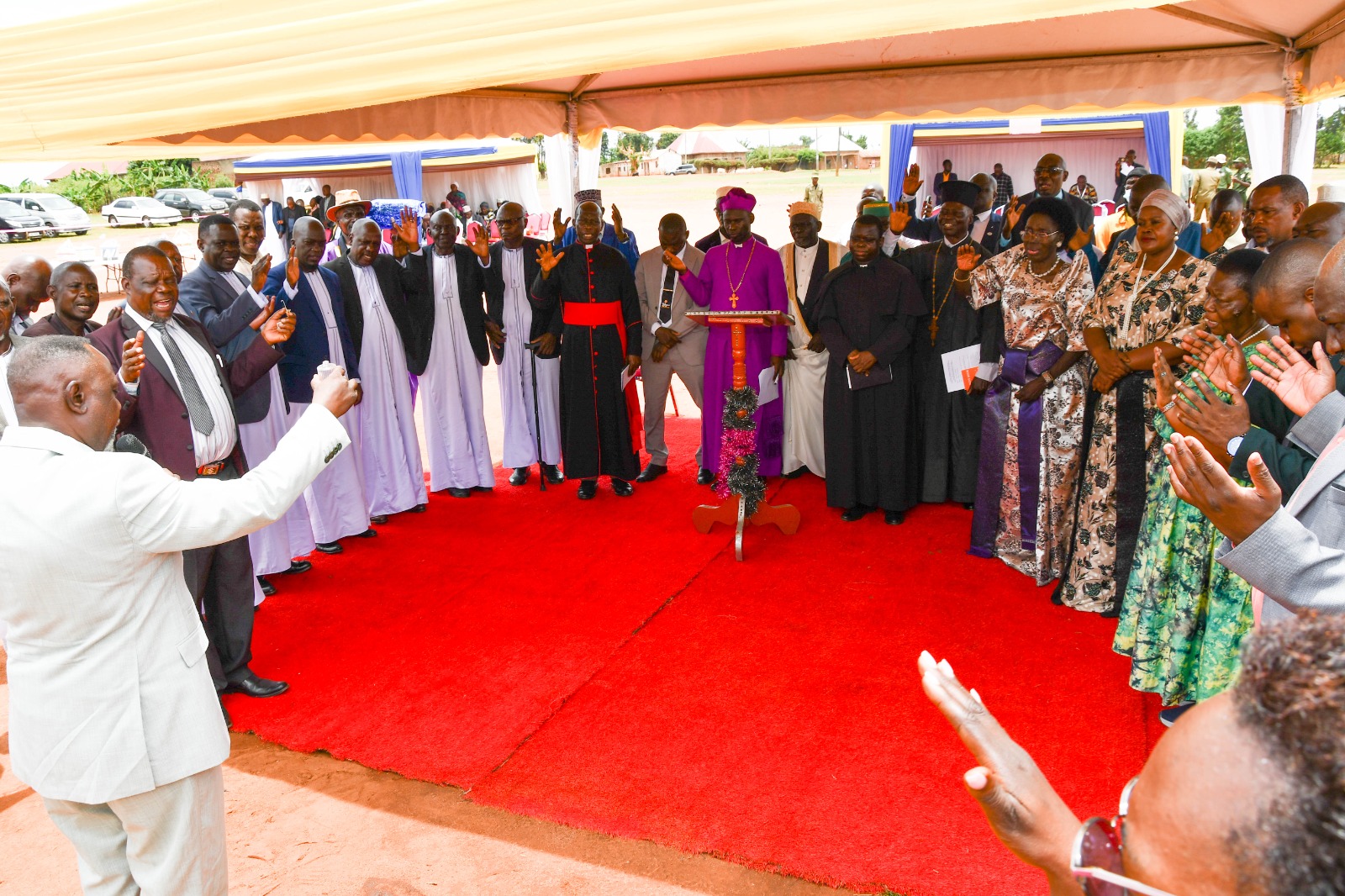
On September 27, more than 2,000 people gathered at Mayuge District Headquarters for the regional climax, which featured interfaith prayers, scripture readings, sermons, intercessions, speeches and anthems. Religious leaders prayed for the economy and wealth creation, the land of Busoga, unity, the Kingdom, children and youth, political and religious leadership, the BCD and Uganda as a nation. The gathering also demonstrated the possibility of bringing different institutions together around a common regional agenda.
Yet the Prayer Week also exposed one of the realities that could determine how quickly the region moves from plans to results. Nakadama called attention to inadequate funding to the BCD, saying the financing gap was delaying the implementation and expansion of development programmes. Religious leaders, led by Assistant Mufti of the Busoga Muslim Region Sheikh Dr. Hussein Bowa, similarly called for greater support to the Consortium, arguing that sustained financing was necessary to consolidate gains and extend interventions to more communities.
The issue is significant because Vision 2030 will ultimately depend not only on the strength of its aspirations, but on the capacity to finance, coordinate and implement programmes at scale. The most important message of the fourth Prayer Week may therefore be what happens after it. The theme, “Let Us Rise Up and Build,” cannot remain confined to seven days of sermons and prayers. If households are to prosper, citizens must engage in productive enterprise.
If agriculture is to create wealth, farmers must have access to skills, markets, technology and value addition. If young people are to become agents of transformation, they need education, practical skills and opportunities. If communities are to develop, leaders and institutions must cooperate around shared priorities. And if Busoga is to realise its 2030 aspirations, development plans must be matched with resources, effective coordination and sustained implementation. The Prayer Week has shown that the region can bring different faiths, institutions and leadership structures into one conversation.
The next challenge is to turn that unity into sustained action.
The media also helped extend the conversation beyond those physically present, with coverage and live broadcasts taking the message of the Prayer Week to wider audiences. That wider conversation matters because Busoga’s development story is not only a regional issue. The transformation of households, agriculture, education, youth and local enterprise contributes to Uganda’s broader development ambitions. The fourth Busoga Prayer Week has ended, but its central message remains. The region has prayed for its economy, its people, its children, its land, its leadership and its future.
Now the rebuilding must continue.
The farmer must build through productive agriculture. The entrepreneur through enterprise. The student through education and skills. The parent through responsible families. The leader through service and coordination. Faith institutions through unity and community mobilisation. Development institutions through partnerships, investment and implementation.
The wall Busoga is being called to build is not made of stones alone. It is made of trust, education, productive agriculture, enterprise, responsible leadership, strong institutions and a shared commitment to the future. The fourth Prayer Week has given the region a moment to pause, pray and reflect on the road travelled.
It has also reminded Busoga that Vision 2030 will not be built by spectators.