

Uganda's Graduates Urged to use skills to tackle Africa's Youth Unemployement .
Former Nigerian President and Chancellor of Cavendish University Uganda, H.E. Goodluck Ebele Jonathan, has challenged graduates to use their professional knowledge, skills and innovations to help tackle Africa’s growing youth unemployment challenge, urging them to become creators of opportunities rather than depend entirely on formal employment.
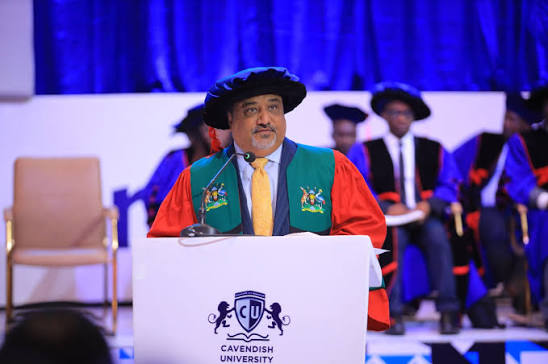
H.E. Jonathan made the remarks on Thursday while presiding over the 15th graduation ceremony of Cavendish University Uganda at Speke Resort Munyonyo Convention Centre, where 1,059 students from 33 nationalities graduated under the theme, “Graduating Global Talent for Employment, Entrepreneurship and Impact.” The graduates included 703 bachelor’s degree holders, 285 master’s graduates, 61 diploma holders and one certificate recipient, adding to Uganda’s growing pool of skilled professionals entering the workforce and other areas of economic activity.
Addressing the Class of 2026, H.E. Jonathan said academic qualifications should not merely be viewed as certificates for securing employment, but as tools that can be used to solve social and economic challenges facing communities and countries.
“Graduation is not the end of your journey; it is actually the beginning of a greater one,” H.E. Jonathan told the graduates.
He urged the graduates to use their professional knowledge to identify challenges within their communities and develop practical solutions that can create businesses, employment and lasting social impact.
“You leave not merely holding a qualification, but carrying the responsibility to make that qualification matter—to use knowledge in service of humanity and create meaningful change wherever your journey takes you,” he said. H.E. Jonathan said Africa’s youth unemployment challenge requires a change in mindset, with graduates moving beyond waiting for limited formal employment opportunities and instead using their professional expertise to create new opportunities.
“Some of you will become entrepreneurs rather than waiting for opportunities. You will create them,” he said.
He said professionals trained in business, technology, agriculture, health, engineering, education and other disciplines can contribute directly to addressing unemployment by turning their knowledge into enterprises, innovations and services that respond to real community needs. H.E. Jonathan also called on African governments and institutions to create an enabling environment in which young professionals can access opportunities and support to transform their ideas into viable enterprises.
He said Africa must increasingly believe in its own young people and home-grown innovations rather than depending excessively on solutions developed outside the continent. According to H.E. Jonathan, Africa’s large and youthful population can become a major economic advantage if young people are properly educated, skilled and supported to participate productively in national development.
He also applauded President Yoweri Kaguta Museveni for supporting education, innovation and skills development in Uganda, saying investment in human capital is critical to preparing young people to contribute to the workforce and wider economic transformation. H.E. Jonathan said graduates were entering a rapidly changing world shaped by artificial intelligence, climate change and evolving global markets, requiring professionals to combine academic knowledge with innovation, integrity, adaptability and continuous learning.
He challenged them to view these changes not only as challenges but also as opportunities to develop new products, services and businesses capable of creating employment for themselves and others. Speaking at the same ceremony, the Minister of State for Trade and Investment, Hon. Sanjay Tanna, challenged the graduates to align their professional skills and innovations with Uganda’s development priorities.
Tanna highlighted agriculture and agribusiness, tourism, minerals and mining, and science, technology and innovation as strategic sectors where Uganda requires skilled professionals capable of contributing to economic transformation. He said Africa’s abundant natural resources, particularly minerals, provide significant opportunities for wealth creation if countries strengthen their capacity to utilise and add value to them.
“Unless Africa starts utilising its own resources and minerals, many countries may continue to remain poor,” Tanna said, urging graduates to identify opportunities within Uganda and apply their professional knowledge to productive activities.
He assured the graduates that Government remains ready to support innovations and initiatives capable of creating employment, strengthening local industries and contributing to national development. The Vice Chancellor of Cavendish University Uganda commended parents and guardians for the sacrifices made to support their children through higher education, noting that reaching graduation requires considerable commitment from both learners and their families.
She said the university has, over the past 15 years, continued to equip students with academic knowledge, professional skills and competencies required to participate effectively in the labour market and contribute to society. The graduation of 1,059 students from 33 nationalities, she said, demonstrates the institution’s contribution to developing professional talent capable of working in Uganda, across Africa and in the wider global economy.
Some of the graduating students also shared testimonies of how their education and support from the university had equipped them with professional skills, confidence and knowledge to pursue careers and contribute to their communities. The ceremony attracted government officials, university leaders, academics, parents, guardians and other distinguished guests. The graduation comes at a time when Uganda and many other African countries are facing the challenge of creating sufficient productive opportunities for a growing population of young people entering the labour market.
The central message from the ceremony was therefore not simply that graduates should find employment, but that they should use their professional skills to help create the opportunities Africa needs. By turning qualifications into enterprises, innovations, professional services and community solutions, graduates can become part of the response to youth unemployment while contributing to broader economic and social transformation.Following the graduation ceremony, H.E. Jonathan is expected to pay a courtesy visit to President Yoweri Kaguta Museveni.
For the 1,059 graduates, the ceremony marked the beginning of a new responsibility: to transform knowledge into practical solutions, professional expertise into opportunity and education into lasting impact for Uganda, Africa and the communities they serve.